
Short-, Mid-, and Long-Term Stays in Tokyo — Why Monthly Apartments Are Often the Best Choice
Deciding where to live in Tokyo depends largely on how long you plan to stay. Below we explain the practical differences between short-term, mid-term, and long-term stays — and why monthly apartments are usually the smartest choice for stays of less than two years.
Overview: Short-, Mid-, and Long-Term Stays
For simplicity we use three categories:
- Short-term: 1 month — 12 months
- Mid-term: 1 — 2 years
- Long-term: 2+ years
Short-Term Stays (1–12 months)
Recommended option: Monthly / serviced apartments.
Benefits
- ✅ Fully furnished — bed, kitchenware, appliances and Wi-Fi included.
- ✅ Utilities often bundled — less paperwork (no need to set up electricity/gas yourself).
- ✅ No Japanese guarantor required and no long-term commitment.
- ✅ Move-in is fast — ideal for students, interns, or professionals on short assignments.
Considerations
- ❌ Monthly cost tends to be higher than a multi-year fixed lease.
Mid-Term Stays (1–2 years)
Even for stays under two years, monthly apartments often remain the best balance of flexibility and cost.
Why monthly apartments work well here
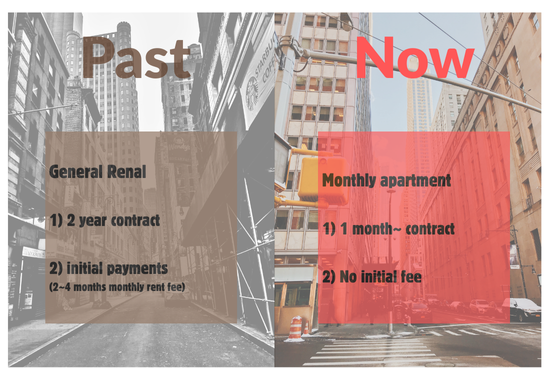
- Traditional Japanese rental contracts are commonly 2-year minimums and include cancellation penalties.
- Long-term moves usually require initial fees — commonly 2–4 months’ worth of rent for deposit, key money, agent fee, and guarantor charges.
- Monthly maintenance, repair and management fees can push a long-term rental’s total monthly cost close to a serviced apartment’s price — but with far less flexibility.
- Monthly apartments are also useful as a temporary home while you search for a long-term rental.
Long-Term Stays (2+ years)
If you plan to stay more than two years, a traditional long-term lease can become more cost-effective: lower base rent per month will typically offset the upfront costs over time.
What to expect for long-term leases
- Japanese ID documents and often a guarantor (or a guarantor company) are required.
- Upfront costs (2–4 months) are normal.
- Less flexibility to end the contract early without penalties.
Why Finding a Long-Term Rental Has Gotten Harder
Recently it has become more difficult to secure standard rental units in central Tokyo because of:
- Population concentration in central wards
- Increased number of foreign residents, international students, and inbound workers
- Tight vacancy rates and higher competition
As a result, monthly apartments are increasingly valuable — they let you lock a safe, comfortable base quickly without being forced into a two-year commitment.
Which Option Should You Choose?
Quick rule:
- Staying less than 2 years → Choose a monthly apartment for flexibility and lower upfront cost.
- Staying 2 years or more → Consider a long-term lease if you can accept paperwork and upfront fees.
Practical Tips
- Use a monthly apartment initially if you’re new to Tokyo — it gives you time to explore neighborhoods and workplaces.
- Compare the total monthly cost (rent + management + utilities) before signing a 2-year lease.
- If you may leave early, confirm the early-termination penalty on any long-term lease.
Need help choosing a monthly apartment?
We specialize in helping foreigners find short- and mid-term monthly apartments across Tokyo. Contact us for a personalized recommendation — including neighborhood fits, commute estimates, and cost comparisons.
Why contact us?
Monthly apartments are usually booked without viewing, and early reservations can save you up to 60%.
With local support, you’ll get better options, better prices, and a smoother start in Tokyo.


 Tokyo Monthly Living
One thought on “Article 6”