Best Monthly Apartments in Tokyo with Easy Airport Access (Haneda & Narita Guide)
If you’re moving to Tokyo for work, study, or a long stay, airport access can be an important factor when choosing a monthly apartment.
The good news? Tokyo has one of the most efficient airport transportation systems in the world. You don’t need to live next to the airport to enjoy convenient access.
No guarantor. 1 month+. English support. Free consultation before arrival.
Article 1
How to Rent a Monthly Apartment in Tokyo: A Step-by-Step Guide
Finding a place to live in Tokyo can feel overwhelming, especially for foreigners who are new to Japan. Between the language barrier, unique rental system, and countless neighborhoods, it’s easy to get lost. But if you are planning a stay of one month or longer, renting a monthly apartment in Tokyo can be the perfect solution.
This guide walks you through the step-by-step process of renting a monthly apartment in Tokyo, covering everything from choosing the right area to signing the contract. Whether you’re a student, professional, or long-term traveler, this will help you settle in smoothly.
Step 1: Research and Choose the Right Area
Tokyo is massive, and each neighborhood offers a different vibe and lifestyle. Before you even look at apartments, decide what matters most to you—commute time, nightlife, cultural attractions, or peace and quiet.
In Tokyo’s 23 wards, real estate listings often distinguish between the central “Three Wards” — Chiyoda, Chuo, and Minato — and the surrounding “sub-centers” such as Shinjuku, Shibuya, Ikebukuro, and Bunkyo. This helps simplify Tokyo’s complex geography for newcomers.
This division reflects not only administrative boundaries but also practical living considerations—location, transit access, and urban functions. For foreigners seeking monthly rentals, choosing between the “central core” and these “sub-center” areas like Bunkyo can be a helpful first step.
Here’s a quick guide to Tokyo’s popular rental areas:
Shinjuku & Shibuya: Vibrant, central, and convenient areas filled with shops, restaurants, and nightlife. Perfect for those who want to live in the heart of the city, though rent tends to be higher.
Ikebukuro & Ueno: Affordable and student-friendly. Ueno offers traditional culture and access to museums, while Ikebukuro is a hub for entertainment and shopping.
Shinagawa: Great for business professionals with easy access to airports and Shinkansen lines. Clean, quiet, and well-connected to central Tokyo.
Naka-Meguro & Ebisu: Trendy and stylish areas popular with young professionals. You’ll find cozy cafés, boutique shops, and beautiful riverside walks.
Bunkyo: A calm, intellectual area home to the University of Tokyo and several
Monthly apartments in Tokyo 23 wards are more flexible than traditional long-term rentals. They usually include furniture, utilities, and internet, which makes them much easier for foreigners.
Typical costs include:
Rent: ¥130,000–¥380,000 for a studio (1R or 1K) in central Tokyo.
Utilities & Wi-Fi & Furniture: usually included in monthly rent. *Area : Chiyoda/Chuo/Shinjuku/Bunkyo/Meguro/Shibuya/Toshima *Space : more than 20 square meters *Built : within 15 years *Others : Foreigner acceptable, no guarantor required
Recent Trends in Tokyo Rental Prices:
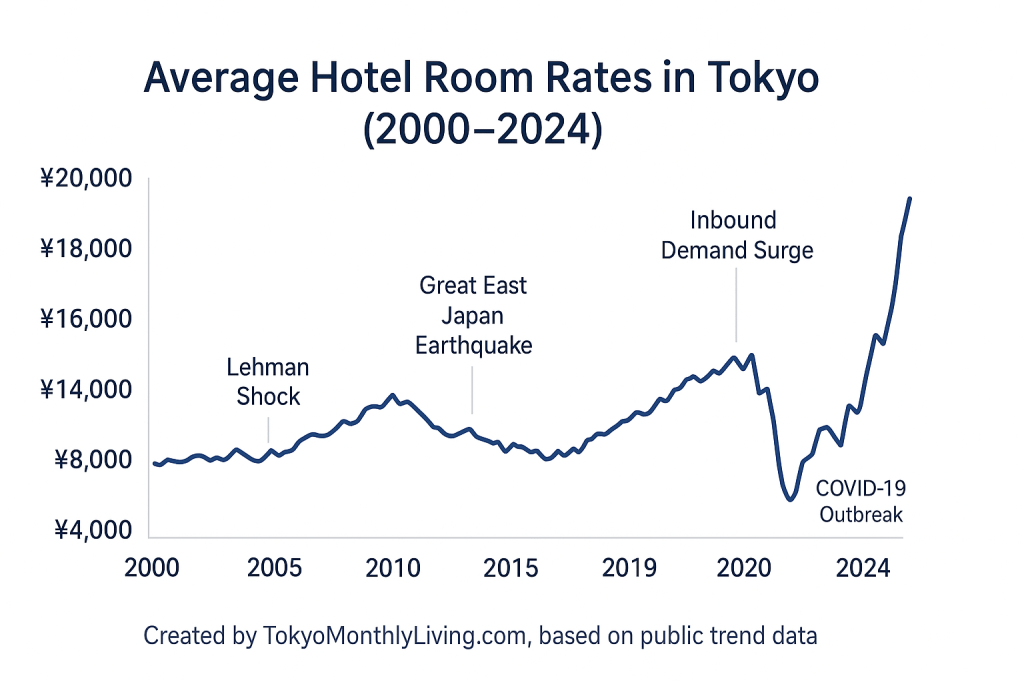
Since the Covid-19 pandemic, accommodation costs across Tokyo’s 23 wards have risen sharply—many areas have nearly doubled in price. Several factors have contributed to this trend:
Growing inbound tourism and international relocation
Depreciation of the Japanese yen
Widespread adoption of dynamic pricing systems
Increased demand ahead of major events such as the Osaka Expo
Compared to hotels or Airbnb, monthly apartments often provide better overall value for those staying longer than a week. They combine affordability with the comfort and privacy of a real home—making them an ideal choice for mid- to long-term stays in Tokyo.
One big advantage of monthly rentals is that you don’t need a Japanese guarantor (which is usually required for long-term leases). The process is simpler and foreigner-friendly.
Once you’ve chosen an apartment, the final steps are straightforward: confirm terms, sign, pay, and move in. Most apartments come fully furnished with basic appliances and bedding.
Conclusion
Renting a monthly apartment in Tokyo doesn’t have to be difficult. By choosing the right area, preparing the necessary documents, and working with a foreigner-friendly agency, you can find a comfortable place to call home—even if it’s just for a few months.
Monthly apartments are usually booked without viewing, and early reservations can save you up to 60%. With local support, you’ll get better options, better prices, and a smoother start in Tokyo.
Tokyo Monthly Apartments vs Airbnb vs Hotels: The Best Option for Long-Term Stay for Foreigners
Tokyo draws many long-term visitors—students, remote workers, interns, and professionals—who plan to stay from one to three months or longer. Choosing the right accommodation can save you money and stress. This guide compares monthly apartments in Tokyo, Airbnb / short-term rentals, and hotels so you can decide which option fits your budget and lifestyle.
Tokyo Travel Trends: Record-Breaking Visitor Numbers in 2024
Tokyo continues to attract an ever-growing number of travelers, both domestic and international. In 2024, the city welcomed approximately 480 million Japanese travelers and 24.8 million international visitors, marking a new all-time high for inbound tourism. This surge highlights how crucial accommodation choices have become—especially in central Tokyo, where demand for short- and mid-term stays has risen sharply.
Year
Domestic Travelers (Total Visits)
International Travelers (Total Visits)
Notes
2022
Approx. 542.7 million
Approx. 3.31 million (–78.2% YoY)
Sharp decline due to the pandemic
2023
Approx. 474.6 million
Approx. 19.5 million
Steady recovery phase
2024
Approx. 479.4 million
Approx. 24.8 million
Record-high number of international visitors
Growing Demand for Accommodation in Central Tokyo
As inbound tourism continues to rise and Japan’s yen remains weak, many international travelers are extending their stays in Tokyo’s 23 wards—particularly in central areas such as Shinjuku, Shibuya, Chiyoda, Minato, and Bunkyo. These districts offer convenient access to transportation, cultural landmarks, and business hubs, making them prime locations for monthly and short-term apartment rentals.
Whether for business, study, or remote work, travelers are increasingly seeking flexible, furnished accommodations that combine comfort, affordability, and local experience—driving new trends in Tokyo’s rental and real estate markets.
Hotels in Tokyo — Convenience at a Premium
Pros
Easy booking via global platforms (familiar process)
Daily cleaning, concierge and consistent service standards
Reliable safety and central locations near business districts and travel area
Cons
Very high cost for extended stays (easily exceed ¥500,000 per month in central Tokyo)
Hotels offering stays of five nights or more — or even allowing such bookings — are extremely limited in Tokyo. One of the largest booking plat form “Jaran” can search room less than 10 days.
Small rooms and no kitchen / laundry facilities
Hidden fees (parking, minibar, service charges)
Best for: short business trips or stays under 5 days.
Airbnb & Short-Term Rentals in Tokyo — Flexible but Risky
Pros
Unlike hotels, Airbnb properties are often located in residential neighborhoods, allowing travelers to experience authentic Tokyo life.
Often include a kitchen, washing machine, and Wi-Fi — offering the comfort of a real home.
Some hosts provide monthly or long-stay discounts.
Cons
Legal Restrictions and Risk of Cancellations Under Japan’s Private Lodging Business Act, short-term rentals are strictly limited — operators can only host guests for up to 180 days per year. In some areas such as Bunkyo Ward or Shinjuku Ward, weekday rentals are even prohibited. Because of these restrictions, many unlicensed or illegal listings still exist, leading to last-minute cancellations, which are frequently reported in the news. During peak seasons, local authorities often issue suspension orders or crackdowns on unregistered hosts.
Safety and Limited On-Site Support Most Airbnb properties do not have on-site staff, meaning that response to theft, emergencies, or natural disasters can be delayed. Even in Japan, where disaster preparedness is generally high, foreign travelers have faced difficulties understanding evacuation routes or emergency contacts, an issue often highlighted in local media. Hygiene and security standards also vary widely between properties, with no consistent quality assurance like in hotels.
Inconsistent Facilities and Cleanliness There are no standardized cleaning or maintenance requirements, so the actual condition of a property may differ significantly from photos. Cleanliness, bedding hygiene, and overall upkeep can be inconsistent — travelers should check reviews carefully before booking.
Best for: Groups, couples, or travelers seeking a “home-like” stay of more than one week — but still a risky choice compared to staying in hotels or monthly apartments.
Monthly Apartments in Tokyo — The Best Value for Long-Term Stays
Monthly apartments in Tokyo are designed for stays of one month or longer, offering fully furnished units equipped with everything you need to live comfortably from day one. Unlike traditional rentals, they require minimal paperwork and no long-term commitments, making them ideal for both business and leisure travelers seeking convenience and value.
Pros
Fully furnished and move-in ready: Each unit typically includes a bed, table, kitchen appliances, washer, and Wi-Fi — so you can start living immediately without extra setup.
Low initial costs: Many apartments require no security deposit, key money, or brokerage fees, keeping upfront costs affordable.
Simple contract process: Application and screening are straightforward and faster compared to standard rental agreements.
Transparent monthly pricing: Utilities and internet are often included, making budgeting easier and avoiding unexpected expenses.
Flexible payment options: Most providers accept credit cards and do not require a Japanese guarantor, making the process easier for foreign residents and travelers.
Ready-to-use infrastructure: Electricity, gas, and water are already connected — no need to arrange new accounts. Internet access is also usually pre-installed.
Cons
Minimum stay requirement: Most properties require at least a one-month stay, which offers less flexibility than hotels or short-term rentals.
Limited hotel-style services: Daily housekeeping, room service, and concierge support are usually not provided.
Best for: Business travelers, long-stay tourists seeking predictable monthly costs, students, or anyone in need of temporary housing — such as during relocation or home renovation.
Most cost-effective for 1–3 months in central areas
How to Choose — Quick Check
🏡 How to Find a Monthly Apartment in Tokyo — Step-by-Step Guide
Finding a comfortable monthly apartment in Tokyo can be easy if you plan ahead. Here’s a simple step-by-step guide for newcomers and long-term visitors.
🥇 Step 1: Define Your Needs First
Before you start searching, decide the basics of your stay:
Stay duration: How long will you stay in Japan?
Location: Which areas fit your lifestyle or commute needs?
Number of people: Solo, couple, or family?
Budget range: How much can you spend per month?
Purpose of visit: Study, remote work, relocation, or travel?
📝 Tip: Knowing these details helps you filter listings faster and avoid unsuitable options later.
🔍 Step 2: Search on Reliable Platforms
Look for properties on trusted English-friendly platforms such as:
GaijinPot Housing
Sakura House
Oakhouse
MetroResidences
Local monthly apartment portals
💡 Pro tip: Compare at least 3–4 platforms — listings and fees vary depending on the operator.
🧾 Step 3: Check What’s Included
Before booking, make sure you understand what is (and isn’t) covered in the rent:
Utilities and Wi-Fi
Bedding and furniture
Cleaning service schedule
Maintenance and repair support
Cancellation and refund policy
🛋️ Tip: Some apartments include everything, others charge utilities separately. Always double-check before signing.
🗝️ Step 4: Confirm Move-in Logistics
Once you find a suitable apartment, confirm the move-in details:
How to pick up the key
Check-in and check-out times
Availability of English-speaking support
Deposit or ID requirements
🔑 Tip: Ask the host for a written confirmation in English — this avoids last-minute confusion on arrival.
✅ Step 5: Check Minimum Stay & Extension Rules
Finally, review the property’s stay policy:
Minimum contract period (usually 1 month)
Possibility to extend your stay
Penalties for early move-out
📅 Tip: If you’re unsure about your exact stay length, choose an apartment with flexible terms.
🌟 Summary
A good monthly apartment = clear plan + trusted source + verified details. Tokyo offers many English-friendly options — once your needs are clear, finding a comfortable home becomes simple and stress-free.
Renting in Tokyo comes with unique costs compared to other cities. Monthly rentals are simpler because they often bundle utilities, furniture, and Wi-Fi into one package.
Monthly apartments are usually booked without viewing, and early reservations can save you up to 60%. With local support, you’ll get better options, better prices, and a smoother start in Tokyo.
Discover Tokyo’s 23 Wards: Where You Stay Shapes Your Experience
Tokyo is not just one city — it’s made up of 23 special wards, each with its own character, community, and lifestyle. From the calm and intellectual atmosphere of Bunkyo to the vibrant nightlife of Shinjuku or the trendy cafés of Shibuya, every area offers something unique.
For anyone planning a monthly stay in Tokyo, choosing the right ward can completely change your experience. Some areas are ideal for business professionals and long-term residents, while others are better suited for students or short-term visitors who want easy access to Tokyo’s cultural spots.
Each ward differs in geography, commercial activity, and living environment — and understanding these differences helps you find the perfect monthly apartment that fits your lifestyle and budget.
In this guide, we’ll walk you through the features of all 23 wards of Tokyo, highlighting what makes each one special and which types of residents and travelers it best suits.
Whether you’re moving to Tokyo for work, study, or a few months of adventure, this overview will help you discover the best areas to live and rent in Tokyo.
Best Areas to Stay in Tokyo — Top 10 Wards Women Wish to Live In
In recent years, many Japanese residents have begun saying, “Tokyo is no longer a place to live.” Rent prices across Tokyo’s 23 wards have reached record highs, making it increasingly difficult for even middle-income residents to find affordable housing. Because of this, surveys that ask “Where would you like to live if money were no object?” offer valuable insight into which areas of Tokyo are truly desirable—not just convenient or cheap.
According to a recent Netorabo Research survey, the following list shows the Top 10 Tokyo Wards Where Women Would Like to Live if Money Were No Object. The ranking focuses on Tokyo’s 23 special wards, reflecting preferences based on safety, lifestyle quality, convenience, and overall livability.
Source: Netorabo Research — “Tokyo 23 Wards: Women’s Top 10 Most Desired Places to Live (If Money Were No Object)”
This ranking is particularly useful for foreign residents, digital nomads, and long-term visitors searching for a monthly apartment in Tokyo. It highlights which areas are most favored by locals — areas that combine safety, comfort, international access, and lifestyle appeal.
For example, Minato, Meguro, and Setagaya wards consistently appear at the top of the list. These neighborhoods offer stylish streets, green parks, excellent restaurants, and international-friendly communities — all factors that make them ideal for long-term stays.
If you’re exploring Tokyo monthly apartments or deciding where to stay in Tokyo, this data can guide you toward wards that are not only convenient but also emotionally appealing and comfortable for everyday living.
We recommend featuring this ranking as part of your accommodation search story — emphasizing that staying in one of these wards means choosing areas loved by locals for their atmosphere, accessibility, and quality of life.
Best Tokyo Wards for Foreigners Staying Long-Term: Shinjuku, Ikebukuro, or Bunkyo?
Choosing the right ward in Tokyo matters—your daily commute, nightlife options, and overall lifestyle depend on it. This guide compares three popular areas for foreigners seeking a monthly apartment in Tokyo: Shinjuku, Ikebukuro, and Bunkyo.
What to consider when choosing a ward
Transit access (near major stations or subway lines)
Monthly rent and availability of furnished units
Local amenities (supermarkets, clinics, international stores)
Overview: Shinjuku is one of Tokyo’s major commercial and transport hubs with endless dining, shopping, and nightlife options. It’s ideal for people who prioritize connectivity and activity.
Pros:
Major station (JR Shinjuku) with lines to nearly everywhere
Variety of entertainment, restaurants, convenience stores
Many serviced apartments and short-term options
Cons: Noisy, crowded, and generally higher rent. Typical furnished 1K monthly rents: ¥130,000–¥180,000.
Overview: Ikebukuro is a large commercial district with big shopping centers, cultural spots, and strong transit links. Rents are generally lower than Shinjuku, making it attractive for students and budget-conscious visitors.
Pros:
Lower average monthly rent (furnished 1K: ¥90,000–¥130,000)
Large shopping malls, anime/culture scene, easy transit
Close to several universities and language schools
Cons: Busy near the station; some neighborhoods can feel less polished than central wards.
3. Bunkyo Ward — Quiet, Academic & Residential
Overview: Bunkyo is home to the University of Tokyo and several educational institutions. It offers a calm, residential environment with good access to green spaces and cultural facilities.
Pros:
Quiet neighborhoods and strong safety reputation
Good for students and researchers
Moderate rents for furnished 1K units: ¥100,000–¥140,000
Cons: Less nightlife and fewer tourist attractions compared to Shinjuku or Ikebukuro.
Rent Comparison (Furnished Studio / 1K)
Shinjuku: ~¥150,000 (average)
Ikebukuro: ~¥110,000 (average)
Bunkyo: ~¥120,000 (average)
How to pick the right ward for you
Prioritize transit needs—if your workplace or school is near Shinjuku, living nearby saves commute time.
Set a realistic monthly rent budget and search wards that fit it.
Consider lifestyle—nightlife vs quiet study-friendly area vs affordable shopping.
Need help finding a monthly apartment in these wards?
We curate foreigner-friendly listings in Shinjuku, Ikebukuro, and Bunkyo. Browse curated listings or contact us for personalized recommendations.
Other Guides for Expats in Tokyo
Once you move in, the key is making your daily life stress-free. This includes setting up utilities, internet, and learning where to shop for essentials.
Monthly apartments are usually booked without viewing, and early reservations can save you up to 60%. With local support, you’ll get better options, better prices, and a smoother start in Tokyo.
Once you have settled into your apartment, the next challenge is learning how to navigate daily life in Tokyo. From grocery shopping to healthcare, mastering these basics will make your life smoother and more enjoyable.
1. Grocery Shopping Guide
Helpful, compact guide to supermarkets in Tokyo’s 23 wards — from budget chains to organic stores.Perfect for people living in or searching for a monthly apartment in Tokyo.
How to use this guide
If you plan a medium- to long-term stay in Tokyo, choose a supermarket type that matches your budget and lifestyle: budget chains for the lowest prices, 24-hour mini-markets for late-night convenience, premium stores for imported and gourmet items, and organic shops for natural / health-focused groceries.
A. Budget – Large Supermarkets (Everyday Value)
Best for day-to-day grocery shopping and saving on basics.
Seiyu — Low prices; many stores open late or 24h. Good selection of imports and basics.
LIFE— Reliable fresh produce and ready-made meals; convenient for families.
Maruetsu / Daiei — Common in residential neighborhoods; solid prices and selection.
B. Budget – Small / 24-Hour Supermarkets (Convenience)
Ideal for late-night returns from work or quick top-ups.
My Basket— Compact, local, very handy for daily essentials.
Maruetsu Petit — Small-format Maruetsu stores, many open 24h; great near stations.
C. Quality – Mid-Size Supermarkets (Imported & Gourmet)
Good balance of quality and variety — popular with expats and food lovers.
Seijo Ishii — Wide range of imported goods, premium deli, cheeses and wines.
Queens Isetan — Department-store-level groceries and seasonal produce.
Santoku — High-quality fresh produce in residential areas.
D. High-End Supermarkets (Luxury & Imports)
For shoppers who prioritize premium ingredients and international brands.
Kinokuniya — Gourmet foods, bakery items, and imported brands.
National Azabu — Wide selection of Western products — popular with foreign residents.
Meidi-Ya— Stable supply of imported groceries and quality wines.
E. Organic / Natural Food Stores (Health-Focused)
Preferred by long-stay expats and health-conscious residents.
Bio c’ Bon — French organic chain; reliable EU-standard organic products.
Natural House — Longstanding natural-food brand with groceries and cosmetics.
Kodawariya — Local natural-food specialty stores in residential neighborhoods.
F. Discount & Bulk / Wholesale-Style
For bulk purchases, parties, or very low-cost stock-ups.
Gyomu Super— Bulk, low prices, frozen and prepped goods ideal for shared apartments.
OK — Low-price, good quality; rapidly expanding in Tokyo.
Don Quijote — Discount chain with groceries and household items in one place.
Quick tips for expats / monthly apartment residents
Choose a supermarket type based on how often you cook and your budget.
For imported ingredients, check Seijo Ishii, National Azabu or Bio c’ Bon.
24h mini-markets are common near stations — great for late arrivals.
Many supermarkets sell ready-made bento and microwavable meals — convenient for busy days.
2. Transport
Tokyo’s 23 wards offer one of the most advanced and reliable transportation networks in the world. With subways, trains, buses, taxis, and ride-hailing apps available everywhere, foreigners staying in monthly apartments in Tokyo can easily move around the city. This guide summarizes all major transportation options in a simple and practical way to help first-time visitors navigate Tokyo without stress.
(1) Subway: The Most Convenient Way to Travel Within Tokyo
The subway is the most common and efficient transportation method inside the 23 wards. It connects nearly all major areas, including business districts, shopping streets, and tourist destinations.
The subway is known for its punctuality, frequent service, and wide coverage. For fast and reliable movement within central Tokyo, the subway is your best option.
(2) Trains: Ideal for Long-Distance and Airport Access
In addition to the subway, Tokyo has a dense train network operated by JR and several private companies.
● JR Lines
Yamanote Line: A loop line connecting major hubs such as Shinjuku, Shibuya, Tokyo, and Ueno.
Chuo / Sobu Line: Convenient for western Tokyo and central areas.
Keihin-Tohoku Line: Runs north–south through major stations like Tokyo, Shinagawa, and Ueno.
● Private Railways
Tokyu
Keio
Odakyu
Keikyu
Tobu
Seibu
These lines mainly connect suburban areas with central Tokyo.
These lines are convenient when traveling to airports or waterfront areas.
(3) Buses: Useful for Areas Not Covered by the Subway
Tokyo’s bus network is extensive and essential for reaching neighborhoods that are not close to a subway or train station — especially helpful for those staying in monthly apartments.
Uber connects you with licensed taxi companies (not private drivers).
English-friendly app for booking and payment.
Estimated fares are displayed before the ride.
During busy hours, wait times may increase.
Other apps like DiDi and GO are also popular in Japan.
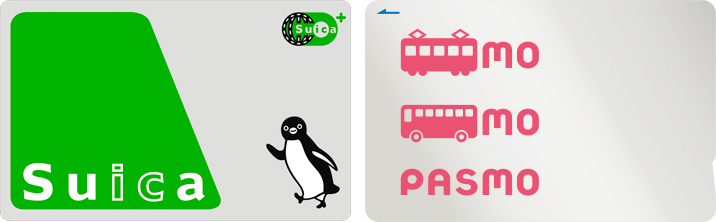
(6) Suica & PASMO: Essential IC Cards for Seamless Travel
Suica and PASMO are rechargeable IC cards that make traveling in Tokyo much easier. They are strongly recommended for anyone staying longer than a few days
● Where you can use them
Subways, JR trains, private trains, buses, monorails
Convenience stores and vending machines
Restaurants and coin lockers
● Smartphone versions available
Supports Apple Pay and Google Wallet
Recharge through apps
Easy to reissue if lost
For long-term stays in Tokyo, these cards are considered essential.
(7) Tokyo’s Transportation Is Complex — Use Google Maps & Route Apps
Tokyo’s transportation network is highly developed but also extremely complex, which can make navigation challenging for newcomers.
● Recommended apps
Google Maps: Simple and beginner-friendly
NAVITIME / Japan Transit Planner: Strong for Japanese rail routes
Japan Travel by NAVITIME: Designed for foreign visitors
These apps help you check travel times, transfer routes, and fares within seconds.
Conclusion
Tokyo’s 23 wards offer a world-class transportation system with many options:
Subways for fast travel within the city
JR and private trains for wide-area connections
Buses for local neighborhoods
Taxis and Uber for safe and comfortable rides
Suica/PASMO for seamless payment across all systems
Google Maps and NAVITIME to avoid getting lost
By using these tools and services, foreigners staying in monthly apartments can navigate Tokyo easily and comfortably.
3. Healthcare
Tokyo’s 23 wards offer some of the best medical access in Japan, with 637 hospitals and medical facilities as of 2023. Among them, Bunkyo Ward stands out as a major medical hub, hosting world-renowned university hospitals such as the University of Tokyo Hospital, Juntendo University Hospital, and Tokyo Medical and Dental University Hospital.
For foreign travelers staying in Tokyo — including those using monthly apartments or mid-term accommodation — the city provides a wide range of options such as English-speaking hospitals, general clinics, emergency care, and telemedicine services. This guide summarizes everything you need to know to access healthcare smoothly in the Tokyo 23 wards.
(1) Types of Medical Facilities in Tokyo
● General Hospitals
Large hospitals with multiple departments and specialists
Many offer emergency services
Examples: Tokyo Medical and Dental University Hospital, Keio University Hospital, Juntendo University Hospital
● Medical Centers
Often public institutions
Specialized centers for pediatrics, cancer care, infectious diseases, and more
Examples: Tokyo Metropolitan Komagome Hospital, Tokyo Metropolitan Children’s Medical Center
● Clinics / Private Clinics
Found everywhere in the city
Suitable for minor illnesses, check-ups, and daily healthcare
Prescriptions can be delivered to your accommodation
Search terms: “online medical consultation Tokyo” or “telemedicine English Japan”.
(5) Types of Pharmacies in Japan
● Prescription Pharmacy (Dispensing Pharmacy)
Accepts prescriptions from hospitals or clinics
Located near major medical facilities
● Drugstores
Sells over-the-counter medicines, cosmetics, snacks, and daily items
Some shops also have dispensing counters
(6) How to Search for Hospitals in Tokyo
Useful tools:
Tokyo Metropolitan Medical Institution Search Service Search by area, specialty, or language support
Japan Healthcare Info (JHI) Provides hospital introductions and booking support for foreigners
Google Maps Use keywords like “English-speaking clinic”, “hospital near me”, or “Tokyo clinic”
(7) About Medical Insurance in Japan
Foreign residents typically join:
National Health Insurance (NHI)
Employee Health Insurance
Coverage: Most treatments are covered at 70%, meaning patients pay only 30% out-of-pocket.
Note: Short-term visitors are not eligible and should use travel insurance.
(8) Important Tips for Foreign Travelers Seeing a Doctor
Bring cash or a credit card — some clinics do not accept credit
Carry your passport and travel insurance documents
Many hospitals require advance reservations
Prescription validity: 4 days
Late-night or weekend medical care may have extra charges
Prepare basic symptom descriptions in English or Japanese (e.g., fever, rash, stomach pain, vomiting, pregnancy)
Conclusion: Safe and Accessible Medical Care in Tokyo
With its large number of hospitals, English-speaking clinics, telemedicine services, and foreigner-friendly support systems, the Tokyo 23 wards offer a reliable medical environment for international visitors. Whether you are staying in a hotel or a monthly apartment in Tokyo, you can access high-quality healthcare when needed.
Use this guide to stay informed and enjoy a safe and comfortable stay in Tokyo.
4. Language
Tokyo’s 23 wards are one of the world’s great big cities — but living here using only English can be harder than many visitors expect. While popular tourist spots and some foreigner-friendly commercial areas offer English support, many everyday situations — shopping, hospital visits, and local government paperwork — may not.
(1) Why English isn’t always enough
It’s not just a matter of English ability. Many Japanese people are shy about speaking a language they’re not confident in and may avoid using English in public. Even if they understand some English, they sometimes prefer not to speak it.
(2) How a little Japanese helps a lot
Learning a few basic phrases or speaking broken Japanese can dramatically improve daily life and travel options. Simple skills like greetings, asking for directions, or reading basic signs will:
make communication smoother
increase the places and services you can use
let you enjoy more local experiences
reduce stress during unexpected issues
(3) Government language support
Tokyo Metropolitan Government and many ward offices offer multilingual support, such as:
multilingual help desks
translated living guides
disaster & emergency info in multiple languages
ward-level interpretation services via apps/LINE in some areas
Check your local ward office website for details and links to services.
(4) Translation apps that help every day
Translation apps are indispensable for day-to-day life in Tokyo. Recommended apps:
Google Translate — text, camera, and conversation translation.
DeepL — high-quality text translation for messages and emails.
VoiceTra — speech translation developed by a Japanese research institute.
Monthly apartments are usually booked without viewing, and early reservations can save you up to 60%. With local support, you’ll get better options, better prices, and a smoother start in Tokyo.
Living in Tokyo can be expensive, but with the right financial strategies, you can save money and reduce stress. From banking options to utility payments, here’s what every foreigner should know.
How to Open a Bank Account in Japan?
When staying in a monthly apartment in Tokyo’s 23 wards, having a Japanese bank account greatly improves your daily life. From receiving salary payments to signing mobile phone contracts, a bank account is essential.
The most foreigner-friendly bank with easy procedures and a nationwide ATM network. Compare to other bank, requirement of staying period in Japan is shorter (3 month vs 6 months).
Mega banks are the most difficult for foreigners to open accounts with. They require customers to fully understand their Japanese-language terms and conditions. The author’s foreign spouse was refused for this reason.
However, if a Japanese-speaking interpreter accompanies you, some branches may allow account opening.
● Regional Banks
Local banks with varying levels of foreigner support.
● Online Banks
Examples: Rakuten Bank, Sony Bank, PayPay Bank. Convenient and app-based, though some require a Japanese credit card or an existing bank account.
(2) Required Documents
Residence Card
Proof of address
Passport
Japanese phone number
Hanko (seal) — sometimes optional
(3) Recommended Banks for Foreign Residents (Ranking)
🥇 1st: Japan Post Bank (Yuucho)
Most foreigner-friendly
ATMs everywhere
Able to open shorter staying period compared to other banks (3m vs 6m)
Lower documentation barriers
🥈 2nd: Online Banks
Simple and fast application
English-friendly interfaces
🥉 3rd: Regional Banks
Good for long-term residents in one area
4th: Mega Banks
High brand trust
Strict requirements
Japanese contract understanding required
Interpreter support may allow approval
(4) Why Mega Banks Are Difficult
Terms and contracts are Japanese only
Staff communicate mainly in Japanese
Long-term stay proof often required
Risk management policies cause strict screening
With a Japanese-speaking companion, approval becomes more likely.
(5) Tips for Opening an Account
Start with Yuucho or an online bank
Prepare all documents before visiting
Update address after moving into a monthly apartment
Bring a Japanese-speaking companion for mega banks
Opening a bank account may feel challenging, but selecting the right bank makes the process much easier. For anyone living in a monthly apartment in Tokyo, having a bank account will help your life in Japan run smoothly.
Lifeline: Electricity, Water, Gas & Internet
This guide explains average utility costs in Tokyo, available providers, billing frequency, and payment methods—useful information for foreigners planning a long-term stay. Many monthly apartments include utilities and internet in the rent, making move-in easy and stress-free.
(1) Average Utility Costs in Tokyo
Based on reference data (HOMES):
Electricity: ¥6,500–¥7,000 / month
Gas: ¥4,000–¥5,000 / month
Water: ¥2,000–¥3,000 / month
Internet: ¥4,000–¥6,000 / month
Total monthly estimate: ¥15,000–¥30,000
Costs may vary depending on seasonal usage (heating in winter, air conditioning in summer) and individual lifestyle habits.
Monthly apartments are usually booked without viewing, and early reservations can save you up to 60%. With local support, you’ll get better options, better prices, and a smoother start in Tokyo.
Short-, Mid-, and Long-Term Stays in Tokyo — Why Monthly Apartments Are Often the Best Choice
Updated: · TokyoMonthlyLiving
Deciding where to live in Tokyo depends largely on how long you plan to stay. Below we explain the practical differences between short-term, mid-term, and long-term stays — and why monthly apartments are usually the smartest choice for stays of less than two years.
✅ Fully furnished — bed, kitchenware, appliances and Wi-Fi included.
✅ Utilities often bundled — less paperwork (no need to set up electricity/gas yourself).
✅ No Japanese guarantor required and no long-term commitment.
✅ Move-in is fast — ideal for students, interns, or professionals on short assignments.
Considerations
❌ Monthly cost tends to be higher than a multi-year fixed lease.
Mid-Term Stays (1–2 years)
Even for stays under two years, monthly apartments often remain the best balance of flexibility and cost.
Why monthly apartments work well here
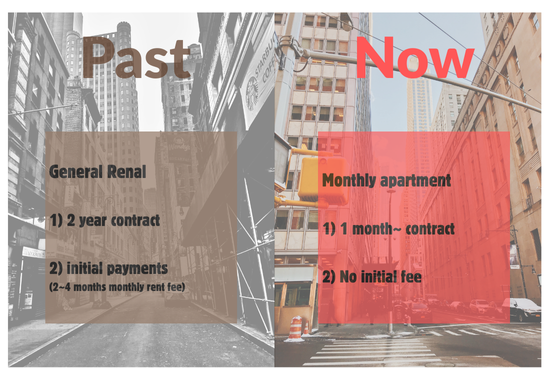
Traditional Japanese rental contracts are commonly 2-year minimums and include cancellation penalties.
Long-term moves usually require initial fees — commonly 2–4 months’ worth of rent for deposit, key money, agent fee, and guarantor charges.
Monthly maintenance, repair and management fees can push a long-term rental’s total monthly cost close to a serviced apartment’s price — but with far less flexibility.
Monthly apartments are also useful as a temporary home while you search for a long-term rental.
Long-Term Stays (2+ years)
If you plan to stay more than two years, a traditional long-term lease can become more cost-effective: lower base rent per month will typically offset the upfront costs over time.
What to expect for long-term leases
Japanese ID documents and often a guarantor (or a guarantor company) are required.
Upfront costs (2–4 months) are normal.
Less flexibility to end the contract early without penalties.
Why Finding a Long-Term Rental Has Gotten Harder
Recently it has become more difficult to secure standard rental units in central Tokyo because of:
Population concentration in central wards
Increased number of foreign residents, international students, and inbound workers
Tight vacancy rates and higher competition
As a result, monthly apartments are increasingly valuable — they let you lock a safe, comfortable base quickly without being forced into a two-year commitment.
Which Option Should You Choose?
Quick rule:
Staying less than 2 years → Choose a monthly apartment for flexibility and lower upfront cost.
Staying 2 years or more → Consider a long-term lease if you can accept paperwork and upfront fees.
Practical Tips
Use a monthly apartment initially if you’re new to Tokyo — it gives you time to explore neighborhoods and workplaces.
Compare the total monthly cost (rent + management + utilities) before signing a 2-year lease.
If you may leave early, confirm the early-termination penalty on any long-term lease.
Need help choosing a monthly apartment?
We specialize in helping foreigners find short- and mid-term monthly apartments across Tokyo. Contact us for a personalized recommendation — including neighborhood fits, commute estimates, and cost comparisons.
Why contact us?
Monthly apartments are usually booked without viewing, and early reservations can save you up to 60%. With local support, you’ll get better options, better prices, and a smoother start in Tokyo.
Finding an apartment in Tokyo as a foreigner can be challenging, but understanding the process makes it much easier. Here are key tips to help you rent confidently and avoid common mistakes.
Step 1 — Decide Your Area
Choose an area based on commute, lifestyle, and convenience. You can find more detail information from Article 1.
Commute & access: proximity to your workplace or major train stations.
Watch availability closely — popular dates fill fast.
Step 4 — Prepare Documents
Most monthly contracts require minimal documents:
Photo ID with face (passport or Residence Card) — sometimes agencies request two IDs depending on the contract.
Credit card — many bookings require card payment for reservation and identity verification.
Unlike long-term rentals, you generally won’t need a guarantor, employer letter, or heavy upfront fees.
Step 5 — Confirm Costs & Pay
Before finalizing, confirm the total upfront and monthly costs:
Monthly rent
Utilities (electricity / water / gas) — sometimes included
Internet / Wi-Fi
Cleaning fee or one-time admin fee
Money-saving tips:
Some providers offer early-bird discounts (examples: 20–60% off for early bookings).
Japanese-only listings can sometimes offer lower prices — use a bilingual agent if you don’t read Japanese.
Monthly Apartment FAQ — Common Questions
Below is a complete FAQ for foreigners renting a monthly apartment in Tokyo, covering procedures, costs, facilities, and move-in guidelines.
1. Do I need a guarantor to rent a monthly apartment?
No. In most cases, monthly apartments do not require a guarantor or a Japanese bank account, making them much easier for foreigners compared to standard long-term rentals.
2. Can I reserve a room before arriving in Japan?
Yes. Most companies accept online reservations from overseas, and payment can be made by credit card or international payment services.
3. What documents are required?
A passport
An emergency contact (can be overseas)
Some agencies may request arrival information, but documentation is minimal.
4. How do I receive the key when moving in?
Most monthly apartments use self check-in. After your payment is confirmed, you will receive:
A digital door code, or
Instructions for picking up a physical key from a lockbox or office
You can usually check in anytime on the move-in date.
5. Can I send luggage to the apartment before I move in?
Yes, but only with prior approval. Contact the agency in advance. They will provide:
Delivery address
Allowed delivery dates
Required labeling
Some buildings cannot accept parcels before check-in, so always confirm first.
6. Are utilities and internet included? How are they paid?
Yes. Utilities such as electricity, water, gas, and Wi-Fi are included in the monthly rent. No additional payments are required.
7. Is the apartment furnished? Are bedding and linens provided?
Yes. Monthly apartments generally include:
Bed
Table & chair
Kitchen appliances
Washing machine
Wi-Fi
Bedding may be included or available as an optional rental set for an additional fee. Check details before booking.
8. Can I cook inside the room?
Yes. Most units include a kitchen or kitchenette equipped with:
Stove
Microwave
Refrigerator
Basic cooking tools (varies by property)
If you need specific items, confirm with the agency in advance.
9. How is room cleaning handled during my stay?
Basic cleaning is the tenant’s responsibility. Most rooms provide a vacuum, mop, and cleaning tools.
Optional paid services may include:
Professional cleaning
Linen replacement
A final cleaning fee is typically included when you book the room.
10. How secure are monthly apartments?
Monthly apartments offer similar security to standard Japanese apartments, including:
Auto-lock building entrances
Security cameras
Digital door locks
On-site management (in some buildings)
Japan is generally safe, and monthly apartments are considered secure for foreign residents.
11. Can I register my address with City Hall?
Some buildings allow address registration, but not all. If required for residency or visa purposes, confirm before reserving.
12. Are visitors or overnight guests allowed?
Policies vary by building. Most properties allow visitors, but overnight guests may require prior notification.
13. What is the difference between a monthly apartment and a long-term rental?
Monthly Apartment
Long-Term Rental
Furnished
Usually unfurnished
No guarantor needed
Guarantor required
No key money or agent fee
Often requires key money + agent fee
1-month minimum stay
Typical 2-year contract
Easy for foreigners
More complex paperwork
14. What happens if I need to cancel?
Cancellation policies differ by company:
Before payment → usually free
After payment → cancellation fees may apply
Always check the terms before booking.
15. Are pets allowed?
Most monthly apartments prohibit pets. Some properties offer pet-friendly rooms — ask the agency if needed.
Monthly apartments are usually booked without viewing, and early reservations can save you up to 60%. With local support, you’ll get better options, better prices, and a smoother start in Tokyo.
What to Do After Arriving in Japan: Short-Term vs Mid-to-Long-Term Stay Guide
Starting a new life in Japan can be exciting—but also confusing, especially for foreign visitors. The actions you need to take after arrival depend largely on your length of stay.
Short-Term Stay (Up to 90 Days)
For tourists, business travelers, and short-term visitors. Short-term visitors do not receive a Residence Card.
1. Get Mobile Internet
SIM card or pocket Wi-Fi at the airport
Passport-only application
2. Move to Your Accommodation
Hotel or monthly apartment
No guarantor or deposit for most monthly apartments
Fully furnished with Wi-Fi
3. Prepare Payment Methods
International credit cards
Debit cards
Online remittance services (Wise, etc.)
Mid-to-Long-Term Stay (Over 90 Days)
For work, study, or research stays. A Residence Card is mandatory.
1. Receive Your Residence Card (Zairyu Card)
A) At the Airport: Most new arrivals with medium to long-term residence status receive their Zairyu Card at major airports like Narita, Haneda, Chubu, and Kansai.
B) At the Municipal Office: If you enter through a different port, you’ll receive your card by mail after registering your address at the local municipal office
2. Register Your Address
Must be completed within 14 days at the city office.
3. Move into a Monthly Apartment
Ideal for the first 1–3 months
Resident registration available
Low initial costs
4. Open a Bank Account
Residence Card
Resident Certificate
5. Sign Up for a Mobile Phone Plan
Phone number + data plan after bank account setup.
Monthly apartments are usually booked without viewing, and early reservations can save you up to 60%. With local support, you’ll get better options, better prices, and a smoother start in Tokyo.
Monthly Apartment Problems in Japan: How Foreigners Can Avoid Trouble
Monthly apartments in Japan are a popular choice for foreigners staying for one month or longer. They are fully furnished, easy to rent, and more affordable than hotels. However, misunderstandings about rules, contracts, and daily life can lead to unexpected problems.
This guide explains the most common monthly apartment problems in Japan, how to avoid them, and what to do if trouble occurs — so you can enjoy a safe and comfortable stay in Tokyo.
1. Things to Check Before Moving In
Understand the Contract Details
Monthly apartment contracts are different from regular rental agreements in Japan. Before signing, make sure you understand:
Payment schedule (full prepayment or monthly payment)
Cancellation and refund policy
Responsibility for damages or broken furniture
If anything is unclear, ask the management company before moving in. English support is often available for foreign residents.
Confirm What Is Included
Check whether utilities, internet, cleaning fees, and consumables are included in the rent. Some items, such as toilet paper or detergent, may not be replenished automatically.
2. Avoiding Problems Right After Move-in
Take Photos and Videos Immediately
On the first day, take photos or videos of the room, furniture, and appliances. This helps prevent disputes when you move out, especially regarding scratches or stains.
Report Any Issues Early
If you find broken appliances or damage, contact the management company immediately. Reporting problems early protects you from unnecessary charges later.
3. Common Monthly Apartment Problems and Solutions
Noise Complaints
Noise is one of the most common issues in Japanese apartments. Thin walls and quiet neighborhoods mean even small sounds can cause complaints.
Avoid loud conversations at night
Use headphones for music or movies
Respond politely if neighbors complain
Garbage Separation Rules
Japan has strict garbage separation and collection schedules. Rules vary by area, and ignoring them can cause trouble with neighbors.
Always follow the garbage guide provided by your apartment management.
Early Move-out or Contract Extension
Plans can change, but early move-out may not include a refund. If you want to extend your stay, contact the management company as early as possible to secure availability.
4. Daily Life Rules Foreigners Should Know
Guest and Overnight Stay Rules
Some monthly apartments do not allow overnight guests. Always check the rules before inviting friends or family.
Replacing Consumable Items
Consumables such as soap, toilet paper, and kitchen supplies are usually the tenant’s responsibility after the initial supply runs out.
Respect Local Customs
Following local rules regarding noise, garbage, and shared spaces helps you avoid problems and enjoy a smoother stay.
5. What to Do If a Problem Occurs
Take photos or keep records as evidence
Contact the apartment management company
Keep written records of communication
Seek third-party advice if the issue is serious
Conclusion: Enjoy a Trouble-Free Stay in Japan
Most monthly apartment problems can be avoided by understanding the rules, communicating early, and respecting local customs. With proper preparation, monthly apartments are one of the best housing options for foreigners staying in Japan.
If you are looking for a foreigner-friendly monthly apartment in Tokyo, we are here to help.
Why contact us?
Monthly apartments are usually booked without viewing, and early reservations can save you up to 60%. With local support, you’ll get better options, better prices, and a smoother start in Tokyo.














 Tokyo Monthly Living